

NOTE: This month, we are working with the Discourse on the Great Forty, the Mahacattarisaka Sutta (MN 117) in The Heart of the Buddha’s Teachings. The following reflection is offered as an introduction this sutra and to our practice together at our Day of Mindfulness.
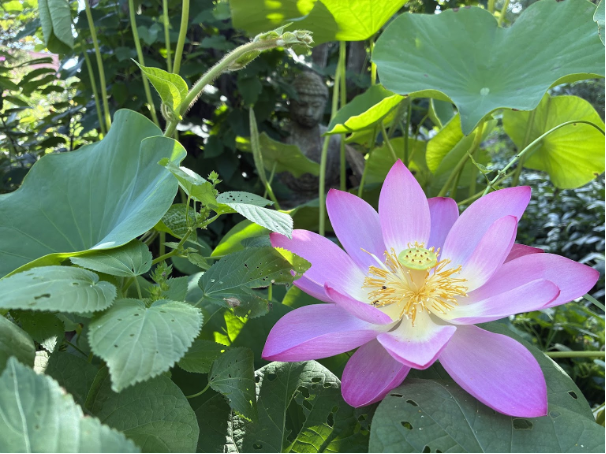
PHOTO: A lotus blooms (pink petals with yellow stamen) in a green garden, in front of a statue of Shakyamuni Buddha

One of the themes woven throughout our study and practice together this year has been how the Eightfold Path is one. We separate out these eight aspects, not because they are ultimately separable, but because moving our attention through each aspect helps us understand the fullness of the path. The more deeply we understand each spoke of the wheel, the more deeply we understand every spoke and the wheel itself. So even if we contemplate and cultivate the path in a linear way, especially at the beginning of our journey, we should do so with this awareness: the Eightfold Path is one path.
In the Discourse on the Great Forty, the Buddha begins with the aspect that is traditionally listed as the eighth factor of the Eightfold Path, Right Concentration. As we explored in chapter 15, the role of meditative absorption and Right Concentration needs to be understood in the context of Awakening. The Buddha’s own life experience demonstrates that it was not that the teachings and meditation techniques he learned from Alara and Uddaka were not useful. Rather, it was not yet clear how these tools could be used to reach the goal. Looking again at the Bhayabherava Sutta, the Buddha explained that at the time of his awakening: “My energy was roused up and unflagging, my mindfulness was established and lucid, my body was tranquil and undisturbed, and my mind was immersed in samādhi [concentration] and unified.” It was Right Concentration – “purified, bright, flawless, rid of corruptions, pliable, workable, steady, and imperturbable” – that established conditions in which Siddhartha could cultivate and realize the Noble Truths.
So, it comes as no surprise that we hear the Buddha begin the Great Forty by grounding us in this insight:
“What, bhikkhus, are the causes and accompanying factors that adorn Right Concentration? They are Right View, Right Thinking, Right Speech, Right Action, Right Livelihood, Right Diligence, and Right Mindfulness. When one-pointedness of mind is accompanied by these seven factors, it is called the Noble Right Concentration adorned with its causes and accompanying factors.”
Turning around from this point, the Buddha then describes how the aspects of the Eightfold Path are mutually supportive, and the factors that result when we do (or do not) practice in this skillful way. Woven throughout are the eponymous forty: twenty wholesome (ten mundane, leading to well-being and good rebirths, and ten transcendent, leading to liberation and Nirvana) and twenty unwholesome (increasingly leading to entanglement in suffering and rebirth in the lower realms). This is a powerful reminder of the insight we have cultivated throughout this formation program: we are always practicing. We are always training the mind. To cultivate awareness and understanding of this, we ask: what actions of body, speech, and mind am I cultivating, in this moment and in this life? With deepening understanding, we continue to look and listen: what do I want to cultivate, and how can I respond to this moment with wisdom and compassion in this moment to develop the heart-mind in this way?
This transformation, the Buddha reminds us, flowers from the insight of the interbeing of Right View, Right Diligence, and Right Mindfulness:
“One makes an effort for the abandoning of wrong resolve & for entering right resolve: This is one’s right effort. One is mindful to abandon wrong resolve & to enter & remain in right resolve: This is one’s right mindfulness. Thus these three qualities—right view, right effort, & right mindfulness—run & circle around right resolve. …
“One makes an effort for the abandoning of wrong speech & for entering right speech: This is one’s right effort. One is mindful to abandon wrong speech & to enter & remain in right speech: This is one’s right mindfulness. Thus these three qualities—right view, right effort, & right mindfulness—run & circle around right speech. …
“One makes an effort for the abandoning of wrong action & for entering right action: This is one’s right effort. One is mindful to abandon wrong action & to enter & remain in right action: This is one’s right mindfulness. Thus these three qualities—right view, right effort, & right mindfulness—run & circle around right action. …
“One makes an effort for the abandoning of wrong livelihood & for entering right livelihood: This is one’s right effort. One is mindful to abandon wrong livelihood & to enter & remain in right livelihood: This is one’s right mindfulness. Thus these three qualities—right view, right effort, & right mindfulness—run & circle around right livelihood.” (tr. by Thanissaro Bhikkhu)
This also carries with it another reminder of an essential theme throughout our contemplation and practice: the twofold movement that pairs abandoning and avoiding the unskillful with taking up and strengthening the skillful. This emphasis brings into focus the healing and transformative power of the Buddhadharma, opening a path where before we saw no path. Returning to another theme, we do not have to wait for conditions to be perfect before we begin cultivating this path. We can begin in the midst of the twenty unwholesome factors. More poignantly, as fellow travelers in this samsaric realm, we all begin in the midst of the unwholesome, in the midst of sorrow, lamentation, pain, grief, and despair. Insight breaks through what felt like an inescapable prison, blossoming with the first hints of wisdom and compassion. As the discourse teaches us:
“When there is wrong view and one knows it is wrong view, it is already Right View. When there is Right View and one knows it is Right View, that is also Right View.”
We hold this in mind as we contemplate and observe the unwholesome factors. Discovering these qualities can be painful, but we can transform that suffering by folding those insights into the path. To know it is wrong view means we are now equipped to abandon the wrong view. And to know it is wrong view means we already have some amount of understanding of Right View, and now we can develop it.
Similarly, the Buddha unfolds two ways of being on this Right path, both mundane and transcendent (supramundane). We begin right where we are, and the progress we make on the path shows up in our regular, day-to-day lives. Just as the unskillful and unwholesome tend to create a spiral towards increasingly harmful actions, the skillful and wholesome tend to create a spiral towards increasingly wise and compassionate actions. These benefits begin showing up even while the heart-mind is still getting free of greed, hatred, and delusion. Starting with Right View, the Buddha explains:
“Bhikkhus, there are two kinds of Right View. There is Right View in which not all the leaks have been stopped. It gives rise to merit but still results in attachment. Then there is Right View that is noble in which the leaks have been stopped. It is supramundane and an element of the Path.”
There is perhaps nothing uniquely Buddhist about this mundane path, and through it the Buddha provides a powerful path open to all and the perfect starting place for most of us. But the more we cultivate that mundane Right-ness in the context of the Buddha’s teachings, the more opportunities we get to encounter and develop those insights that the Buddha described as truly transformative, “in which the leaks have been stopped.” We understand more and more what the Buddha meant by Ignorance, and how easily that ignorance gives rise to the defilements of greed, hatred, and delusion. We understand more and more how the twenty unwholesome arise in this way, out of our unskillful relationship with impermanence, suffering, and emptiness. And we understand more and more why the Buddha stayed resolute on his path out of this suffering, and how and why this path is something we, too, can cultivate.
This is also why the Buddha adds two more factors with Awakening, the fulfillment of a Tenfold Path:
“In one of right view, right resolve comes into being. In one of right resolve, right speech comes into being. In one of right speech, right action.… In one of right action, right livelihood.… In one of right livelihood, right effort.… In one of right effort, right mindfulness.… In one of right mindfulness, right concentration.… In one of right concentration, right knowledge.… In one of right knowledge, right release comes into being. Thus the learner is endowed with eight factors, and the arahant with ten.” (tr. by Thanissaro Bhikkhu)
This brings us full circle to the goal of the path and the Buddha’s description of that fruition in the Bhayabherava Sutta:
“When my mind had become immersed in samādhi like this—purified, bright, flawless, rid of corruptions, pliable, workable, steady, and imperturbable—I extended it toward knowledge of the ending of defilements. I truly understood: ‘This is suffering’ … ‘This is the origin of suffering’ … ‘This is the cessation of suffering’ … ‘This is the practice that leads to the cessation of suffering’. I truly understood: ‘These are defilements’ … ‘This is the origin of defilements’ … ‘This is the cessation of defilements’ … ‘This is the practice that leads to the cessation of defilements’.
“Knowing and seeing like this, my mind was freed from the defilements of sensuality, desire to be reborn, and ignorance. When it was freed, I knew it was freed.
“I understood: ‘Rebirth is ended, the spiritual journey has been completed, what had to be done has been done, there is nothing further for this place.’
“This was the third knowledge, which I achieved in the final watch of the night. Ignorance was banished and knowledge arose; darkness was banished and light arose, as happens for a meditator who is diligent, keen, and resolute.”
Thank you, once again, for your diligent practice together throughout this year. As we enter third year of the practice of the Four Noble Truths, we can pause and reflect again on the ongoing, unfolding gift of the Dharma. The Year One capstone invited us to contemplate how “the highest Wheel of the Dharma has been set in motion,” never to be turned back. The Buddha evokes this same image in the Great Forty Discourse:
“Thus, bhikkhus, there are twenty factors supporting the wholesome and twenty factors supporting the unwholesome. This Dharma teaching on the Great Forty has been set in motion and cannot be turned back by any monk, brahman, god, Mara, Brahma, or anyone in the world.”
Thank you for being part of this ever-turning wheel, practicing together on the path that leads to the end of every kind of suffering!
Namo A Di Da Phat
*In addition to the translation in the book, you can also find the Discourse on the Great Forty, the Mahacattarisaka Sutta (MN 117) several places online. You may benefit from trying different translations, such as:

Reflect:
The Discourse on the Great Forty (the Mahacattarisaka Sutta, MN 117) is organized around the teaching that there “are twenty factors supporting the wholesome and twenty factors supporting the unwholesome.” Based on your study and practice of the Eightfold Path, and your contemplations on this sutta, reflect:
- The Buddha explains that “When there is wrong view and one knows it is wrong view, it is already Right View. When there is Right View and one knows it is Right View, that is also Right View.”
- Why is recognizing wrong view itself an aspect of Right View?
- How does the Buddha apply Right View to other factors of the Eightfold Path?
- How does this insight relate to the 40 factors and shape the practice of the Eightfold Path?
2. Use the following table of parallel translations of the two kinds of Right View:
| Thich Nhat Hanh: | Bhikkh Bodhi: | Thanissaro Bhikkhu: | Bhikkhu Sujato: |
| “Bhikkhus, there are two kinds of Right View. | “Right view, I say, is twofold: | “Right view, I tell you, is of two sorts: | “Right view is twofold, I say. |
| There is Right View in which not all the leaks have been stopped. | there is right view that is affected by taints, | There is right view with effluents, | There is right view that is accompanied by defilements, |
| It gives rise to merit but still results in attachment. | partaking of merit, ripening in the acquisitions; | siding with merit, resulting in acquisitions [of becoming]; | partakes of good deeds, and ripens in attachments. |
| Then there is Right View that is noble in which the leaks have been stopped. | and there is right view that is noble, taintless, | there is right view that is noble, without effluents, | And there is right view that is noble, undefiled, |
| It is supramundane and an element of the Path.” | supramundane, a factor of the path.” | transcendent, a factor of the path.” | transcendent, a factor of the path.” |
- Why is it important to understand that there is a kind of Right View “that is [still] accompanied by defilements”?
- What does the Buddha mean by Right View that “gives rise to merit but still results in attachment”?
- How do the two types of Right View further encourage the cultivation of the Eightfold (and eventually Tenfold) Path?
3. Translators have used different words to describe the process of transformation and liberation in The Discourse on the Great Forty. For example:
• “give up” and “take upon” (Thich Nhat Hanh);
• “abandon” and “enter” (Bhikkhu Bodhi and Thanissaro Bhikkhu); and
• “give up” and “embrace” (Bhante Sujato).
Reflecting on this movement from unskillful to skillful:
- How does this language connect with the four pathways (two unwholesome paths and two wholesome)?
- How is this a reflection of the Buddha’s approach of offering a gradual path?
- In what ways do you find this happening in your practice?
4. In chapter eleven on Right Mindfulness, the Most Venerable Thich Nhat Hanh wrote that:
“It can take years to transform a habit energy, but when we do, we stop the wheel of samsara, the vicious cycle of suffering and confusion that has gone on for so many lifetimes.”
In this sutra, the Buddha then proposes that his teaching sets in motion another wheel:
“This Dharma teaching on the Great Forty has been set in motion and cannot be turned back by any monk, brahman, god, Mara, Brahma, or anyone in the world.”
- Why might this process “take years to transform a habit energy”? How does this reality inform your aspirations for practice?
- How does the Buddha’s description of the twenty unwholesome factors demonstrate the trap of samsara? Similarly, how does the description of the twenty wholesome factors demonstrate transformation and liberation?
- In contrast to the wheel of samsara, what is the significance of the Buddha describing his teaching as setting another wheel “in motion [that] cannot be turned back”? How does this reality inform your aspirations for practice?
Practice:
- Set aside time to regularly read or chant the Discourse on the Great Forty, the Mahacattarisaka Sutta (MN 117). In addition to the Most Venerable Thich Nhat Hanh’s translation, you may benefit from reciting translations by others, such as:
• Translation by Thanissaro Bhikkhu;
• Translation by Bhikkhu Bodhi; and
• Translation by Bhikkhu Sujato.
2. Return to and review your reflections from the Year One Capstone. What are some of the ways those insights are reflected in your studies and practices with the Eightfold Path? What continued growth do you notice in the skillful ways you have learned to relate to, heal, and transform suffering in your life? Connect this with your practice of dedicating merit, beginning with that deep awareness of and gratitude for how you have benefited from the practices of others in the past (making your practice possible) and then nourishing the aspiration to similarly practice for the benefit all beings. Incorporate this practice into your daily life, both formally and informally.
3. Return to the outline of your daily practice organized around the Eightfold Path.
• What stands out to you?
• How has practicing with the Eightfold Path helped clarify what each aspect of the Path means to you, both in understanding and in application?
• What aspirations and practices do you want to carry forward?
• How might you include continuing this practice of reflection, discerning and adapting your practice over time?
Remember: the goal of this practice is to match the insights we cultivate through the Buddha’s teachings with our personal and changing circumstances. Some habits will become long-term, while others may be more situational. Paying attention to our changing conditions and adapting our practice are also part of the path.