

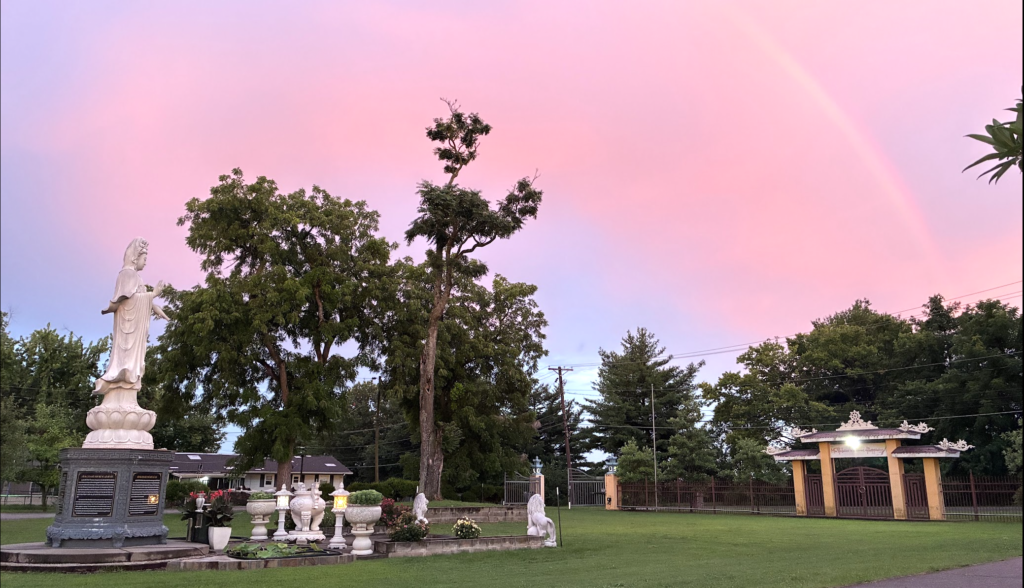
A rainbow crosses a pink and blue sky near dusk, stretching above the courtyard statue of Quan Am Bodhisattva at Dinh Quang Buddhist Temple.
NOTE: This month, we are working with the final spoke of the Eightfold Path described by the Most Venerable Thich Nhat Hanh in The Heart of the Buddha’s Teachings. The following reflection is offered as an introduction this chapter and to our practice together at our Day of Mindfulness.

The foundational teaching on Right Livelihood given by the Buddha is in the Vaṇijjā Sutta (AN 5:177):
“Monks, a lay follower should not engage in five types of business. Which five? Business in weapons, business in living beings, business in meat, business in intoxicants, and business in poison.”
Each of these occupations carry within them the power to harm living beings, often especially and explicitly leading to death. As we cultivate the awakened heart, the consequences of our actions, personally and collectively, become ever clearer, and we naturally want to reduce the harm we cause and participate in, in every way, including with our livelihood. The Most Venerable Thich Nhat Hanh expresses this aspiration as learning “to find a way to earn your living without transgressing your ideals of love and compassion.” When we take this seriously, we understand very deeply that “Our vocation can nourish our understanding and compassion, or erode them.” At its core, the practice of Right Livelihood is to find a job that does not explicitly and directly harm living beings, especially human beings.
But, as we have contemplated all along this path, the path includes not just what we do, but how we do something. Our work becomes an opportunity to practice and cultivate, for example, integrity. For example, the lessons the Buddha taught in the Sevitabbāsevitabba Sutta (MN 114) can be directly applied to the decisions and habits we make at work, both personally and collectively:
“You should not cultivate the kind of bodily behavior which causes unskillful qualities to grow while skillful qualities decline. And you should cultivate the kind of bodily behavior which causes unskillful qualities to decline while skillful qualities grow.”
At the workplace, this aspiration to live with integrity invites us to reflect on how we conduct business, without relying on deceit, threats, tricks, or criminal or immoral tactics, as well as the commitment to refrain from profiting from the suffering of others. At the same time, we can use our time at work to cultivate skillful qualities, such as honesty, generosity, goodwill, and understanding. We can bring each of the Five Precepts and Mindfulness Trainings into awareness with attention to employment as an expression of Right Livelihood and Right Effort. As the Most Venerable Thich Nhat Hanh teaches us,
“If you are able to work in a profession that helps realize your ideal of compassion, be grateful. And please try to help create proper jobs for others by living mindfully, simply, and sanely. Use all of your energy to try to improve the situation.”
Finally, we cannot separate our broader cultures and our personal lifestyles from the practice of Right Livelihood. As Thay Nhat Hanh writes, “Right Livelihood is a collective matter. The livelihood of each person affects everyone else.” Our economic and social conditions shape the jobs that are available and the choices we can make. We are not immune from being influenced by the realities of poverty and wealth around us, including the legal and cultural norms that make up our communities. Too often, our societies depend on and necessitate unskillful livelihoods, profiting from exploiting, dominating, and even killing living beings. If we cannot find a way to practice skillfully, alone and together, then the situation will quickly become overwhelming. When the path to change is slow and difficult, it is all the more important to make this transformation a part of the practice. As Thich Nhat Hanh teaches:
“Everything we do contributes to our effort to practice Right Livelihood. It is more than just the way we earn our paycheck. We cannot succeed at having a Right Livelihood one hundred percent, but we can resolve to go in the direction of compassion and reducing suffering. And we can resolve to help create a society in which there is more Right Livelihood and less wrong livelihood.”
From this we can come to understand that the way we manage a household and finances is also tangled up with the employment and income we need or desire. At the very least, we can become aware of these conditions and how they empower or limit our practice of Right Livelihood, personally and collectively.
The Buddha recognized this in the Dīghajāṇu Sutta (AN 8:54), where he included livelihood in his discussion of what conditions support a lay person’s happiness and well-being. Here the Buddha taught that a well-tuned, balanced livelihood includes not only the occupation, but also how finances are managed:
“… knowing the income and outflow of his wealth, maintains a livelihood in tune, neither a spendthrift nor a penny-pincher, (thinking,) ‘Thus will my income exceed my outflow, and my outflow will not exceed my income.’”
To guard against extravagance, the Buddha especially encouraged us to be aware of:
“four drains on one’s store of wealth: being debauched in sex; being debauched in drink; being debauched in gambling; and having evil people as friends, associates, & companions. Just as if there were a great reservoir with four inlets and four drains, and a man were to close the inlets and open the drains, and the sky were not to pour down proper showers, the depletion of that great reservoir could be expected, not its increase. In the same way, these are the four drains on one’s store of wealth: being debauched in sex, being debauched in drink, being debauched in gambling, and having evil people as friends, associates, & companions.”
Similarly, we can turn to the Taṇhāmūlaka Sutta (AN 9.23) for the Buddha’s teaching on how stinginess is part of a chain of “nine things rooted in craving”:
“And what are the nine things rooted in craving? Craving gives rise to searching. Searching gives rise to gaining material things. Gaining material things gives rise to evaluation. Evaluation gives rise to desire and lust. Desire and lust gives rise to attachment. Attachment gives rise to ownership. Ownership gives rise to stinginess. Stinginess gives rise to safeguarding. Owing to safeguarding, many bad, unskillful things come to be: taking up the rod and the sword, quarrels, arguments, and disputes, accusations, backbiting, and lies. These are the nine things rooted in craving.
From these teachings, we begin to get a fuller sense of how the practice of Right Livelihood is integrated into the Eightfold Path. The aspiration to live with an ethical occupation means that we are careful to make a living doing something that does not profit from the suffering, especially the death, of sentient beings. The aspiration to live with integrity invites us to reflect on how we do our jobs, without relying on harmful habits, such as deceit, threats, tricks, or criminal or immoral tactics, and without profiting from the suffering of others. Instead, work becomes an opportunity to practice skillful habits, such as honesty, generosity, goodwill, and understanding. And the aspiration to maintain “a livelihood in tune” invites us to reflect on how to wisely use resources and to live within our means, avoiding both miserliness and extravagance. And we do this with insight into the complexity of our economic and sociopolitical worlds. Transformation is possible, though it requires our persistent, compassionate practice. Remembering again the Most Venerable Thich Nhat Hanh’s words, we are committed to healing the suffering born of wrong livelihood and cultivating Right Livelihood, for ourselves and all species:
“We cannot succeed at having a Right Livelihood one hundred percent, but we can resolve to go in the direction of compassion and reducing suffering. And we can resolve to help create a society in which there is more Right Livelihood and less wrong livelihood.”
Namo A Di Da Phat
Reflect:
1) Why is Right Livelihood a part of the Eightfold Path? How does the Most Venerable Thich Nhat Hanh connect earning a living to nourishing your “ideals of love and compassion”?
2) What does is mean that “Right Livelihood is a collective matter”? Why is it that, even though “We cannot succeed at having a Right Livelihood one hundred percent,” “Everything we do contributes to our effort to practice Right Livelihood”?
3) What are some ways that we can “practice mindfulness in the workplace”? How is this also an expression of Right Livelihood?
4) How does the resolution “to help create a society in which there is more Right Livelihood and less wrong livelihood” demonstrate the interbeing of the Eightfold Path?
Practice:
1) Reflect on the list of livelihoods that the sutras encourage practitioners to avoid: “not dealing in arms, in the slave trade, the meat trade, the sale of alcohol, drugs, or poisons; or making prophecies or telling fortunes.” What are some of the ways that this avoidance is an expression of wisdom and compassion? How can those principles help guide your own practice of Right Livelihood? How have you/do you personally discern what is an appropriate and Right Livelihood?
2) Reflect on the three aspirations of Right Livelihood outlined above:
- to live with an ethical occupation (careful to make a living doing something that does not profit from the suffering, especially the death, of sentient beings);
- to live with integrity (to do our jobs, without relying on harmful habits, such as deceit, threats, tricks, or criminal or immoral tactics, and without profiting from the suffering of others, while instead cultivating skillful habits, such as honesty, generosity, goodwill, and understanding at the workplace); and
- to maintain “a livelihood in tune” (to wisely use resources and to live within our means, avoiding both miserliness and extravagance).
How have you experienced each aspect, both personally and collectively? Which aspects of Right Livelihood do you consider strengths? Which do you consider limitations?
3) Continue outlining a daily practice organized around the Eightfold Path:
- What does Right Livelihood mean to you?
- What aspirations do you have for the cultivation of Right Livelihood?
- What practice(s) will you develop to support that cultivation?
- How will you recognize growth in the practice of Right Livelihood?
Remember: the goal of this practice is to match the insights we cultivate through the Buddha’s teachings with our personal and changing circumstances. Some habits will become long-term, while others may be more situational. Paying attention to our changing conditions and adapting our practice are also part of the path.