

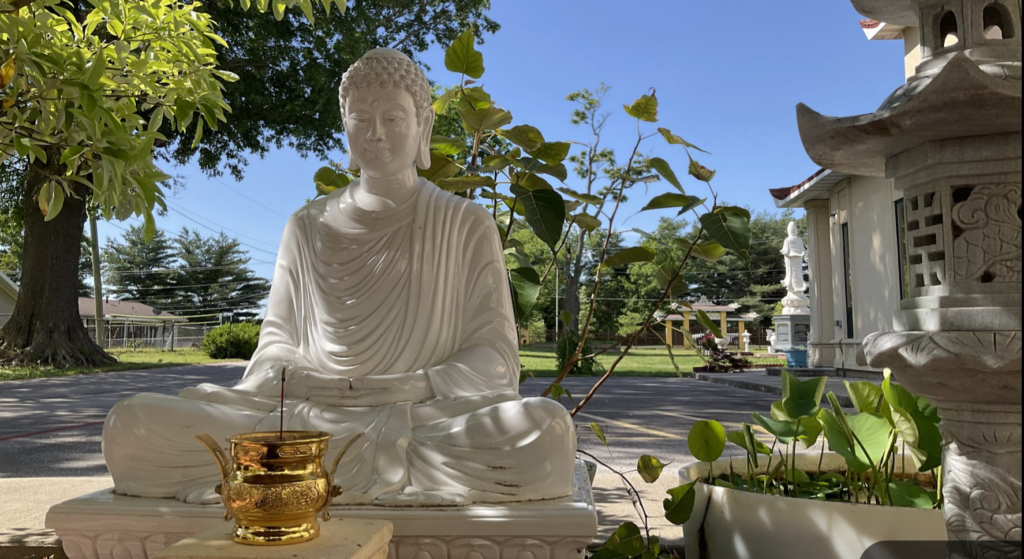
The Buddha in meditation, displaying the dhyana mudra.
Right Concentration, the Most Venerable Thich Nhat Hanh teaches us, means “‘maintaining evenness, neither too high nor too low, neither too excited nor too dull. Another Chinese term sometimes used for concentration means ‘the abode of true mind.'” This chapter is a summary of several important teachings describing this abode, including:
- Two types of concentration (active and selective);
- Nine Levels of Meditative Concentration (the four dhyanas and the five formless concentrations); and
- “Hundreds of Concentrations” (including concentration on impermanence, concentration on nonself, concentration on Nirvana, Shurangama Samadhi, the Saddharmapundarika Samadhi, and the Avatamsaka Samadhi).
Importantly, the Most Venerable frames this chapter with a reminder of both the power and pitfall of concentration. Used rightly,
“To practice samadhi is to live deeply each moment that is given us to live. Samadhi means concentration. In order to be concentrated, we should be mindful, fully present and aware of what is going on. Mindfulness brings about concentration. When you are deeply concentrated, you are absorbed in the moment. You become the moment. That is why samadhi is sometimes translated as ‘absorption.’ Right Mindfulness and Right Concentration lift us above the realms of sensual pleasures and craving, and we find ourselves lighter and happier. Our world is no longer gross and heavy, the realm of desires (karma dhatu). It is the realm of fine materiality, the realm of form (rupa dhatu).”
But this very power necessitates awareness of its misuse:
“We don’t use concentration to run away from our suffering. We concentrate to make ourselves deeply present. When we walk, stand, or sit in concentration, people can see our stability and stillness. Living each moment deeply, sustained concentration comes naturally, and that, in turn, gives rise to insight. … When you use concentration to run away from yourself or your situation, it is wrong concentration. Sometimes we need to escape our problems for relief, but at some time we have to return to face them. Worldly concentration seeks to escape. Supra-mundane concentration aims at complete liberation.”
These essential themes also return us to the insight that the Eightfold Path is one path. All eight aspects help us develop the fullness of the practice, and none of the spokes on the wheel of Dharma are in competition with each other. Each aspect is important and each aspect points back to and contains the other seven. For example, Ajahn Suwat teaches that:
“In general terms, Right Concentration means establishing the mind rightly. On one level, this can apply to all the factors of the path. You have to start out by setting the mind on Right View.
“In other words, you use your discernment to gather together all the Dhamma you’ve heard. Then when you set the mind on Right Resolve, that’s also a way of establishing it rightly. Then you set it on Right Speech, speaking only things that are right. You set it on Right Action, examining your actions and then forcing yourself, watching over yourself, to keep your actions firmly in line with what’s right. As for Right Livelihood, you set your mind on providing for your livelihood exclusively in a right way. You’re firm in not making a livelihood in ways that are wrong, not acting in ways that are wrong, not speaking in ways that are corrupt and wrong. You won’t make any effort in ways that go off the path, you won’t be mindful in ways that lie outside the path. You’ll keep being mindful in ways that stay on the path. You make this vow to yourself as a firm determination. This is one level of establishing the mind rightly.”
This points out another important part of establishing this practice: we are not starting from scratch. We can understand that we have already been developing concentration throughout our lives, including both helpful and unhelpful habits, and a mixture of both. We have varying levels of experience and success in cultivating both mundane concentration, required for the tasks we do every day, and wrong concentration, as when we get absorbed in greed, hatred, or delusion. We have also cultivated Right Concentration, or the seeds of Right Concentration, any time we have applied the factors of the Eightfold Path and acted in alignment with wisdom and compassion. As this practice ripens, we have fewer obstacles and distractions (previously created through unskillfulness) and more resources and habits (developed through wholesome acts of body, speech, and mind).
Reflecting like this also helps us understand Thich Nhat Hanh’s teaching on two types of concentration, active and selective. We can recognize these approaches in our daily activities, in each of the path factors, and in formal meditation practice. When we cultivate active concentration, “the mind dwells on whatever is happening in the present moment, even as it changes.” Drawing from the images of Vietnamese poet and Dhyana Master Huong Hai, we can relate it to the experience of wind whistling through the bamboo, known without grasping. Similarly, active concentration is like a still lake reflecting a bird, cloud, or “whatever comes along. … When the object of our concentration has passed, our mind remains clear, like a calm lake.” In the poet’s words:
“A silver bird
flies over the autumn lake.
When it has passed,
the lake’s surface does not try
to hold on to the image of the bird.”
We can also recognize selective concentration when we choose an object of awareness and stay with it. We allow other sense contact to pass by in the background while “our attention is focused on the object.” This can lead to deep levels of meditative absorption or immersion. Again: “Right Mindfulness and Right Concentration lift us above the realms of sensual pleasures and craving, and we find ourselves lighter and happier. Our world is no longer gross and heavy, the realm of desires (karma dhatu). It is the realm of fine materiality, the realm of form (rupa dhatu).”
Ajahn Thanissaro outlines how supports in the practice in On the Path, focusing on “the reciprocal relationship between the discernment path-factors on the one hand, and right concentration on the other.” These follow the uses of concentration in the Buddha’s teachings: pleasant abiding in the here and now, developing knowledge and vision, developing mindfulness and alertness, and ending the effluents.
- “When you develop concentration for the purpose of a pleasant abiding here and now, right view provides insight into fabrication that enables you to enter right concentration, while noble right resolve—in its role as directed thought and evaluation—helps you to adjust the mind and its object so that they can stay snugly together, using the resulting pleasure to saturate the body. At the same time, the discernment factors—as long as you keep them in mind—warn you not to mistake the pleasure of concentration for the higher well-being of unbinding. … The pleasure that comes from the first use of concentration allows you to use your discernment effectively in overcoming attachment to sensuality.”
- “If you develop concentration for the purpose of knowledge and vision, discernment reminds you to regard those powers with a detached sense of humor, so that you don’t develop undue pride around them or waste time playing with them and neglecting the goal. … The sense of saṁvega that can come from using psychic powers wisely can strengthen your right resolve to find a way beyond suffering.”
- “Similarly, when you develop concentration for the purpose of mindfulness and alertness, right view keeps you focused on seeing events as events, in terms of the four frames of reference, and prevents you from diverting your frame of reference to the world and ruining your concentration attainments by developing pride around them. Right view also provides you with a vocabulary to distinguish different kinds of events, so that you can pinpoint exactly where craving has created a location around which becoming has coalesced. … The improved mindfulness and sharpened alertness that come from the third use of concentration can make you more sensitive to the processes of fabrication as they are happening, both so that you can clearly recognize when skillful or unskillful states are arising, and so that—as the path develops—you don’t mistake a fabricated state of mind for the unfabricated.”
- “When you develop concentration for the purpose of ending the effluents, right view and right resolve help you to refine your concentration to higher and higher levels by pointing out the ways in which the various levels are fabricated. Then, once you have mastered concentration, you can then use this same knowledge to develop dispassion for concentration on all levels—seeing it in terms of the five aggregates or the three types of fabrication—and so gain total release. … [Y]ou refine your sense of what constitutes happiness, at the same time discerning the limits of how far fabrication can go. This insight inclines the mind to be willing to abandon everything it has gained from even the most skillful fabrications, in exchange for an unfabricated happiness. At the same time, it enables you to recognize the unfabricated as unfabricated when you encounter it.”
This is the practice that Siddhartha used as he sat under the bodhi tree until he achieved full and complete liberation. But he did not begin there, and his path included both developing these deep skills and then directly experiencing both their value and their limitations. He had to come to discern how and when they could support awakening. In Old Path, White Clouds, Thich Nhat Hanh tells the story of how Siddartha practiced with accomplished teachers before his Enlightenment. Chief among these were Ālāra Kālāma and Uddaka Rāmaputta, masters of concentration. As the Most Venerable tells it:
“While sitting in meditation he was able to let go of thoughts and even of clinging to his past and future, and he attained a state of wondrous serenity and rapture, although he felt the seeds of thought and attachment still present in him. Several weeks later, Siddhartha reached a higher state of meditation, and the seeds of thought and attachment dissolved. Then he entered a state of concentration in which both rapture and non-rapture ceased to exist. It felt to him as though the five doors of sense perception had completely closed, and his heart was as still as a lake on a windless day.
“When he presented the fruits of his practice to Master Alara, the teacher was impressed. He told Siddhartha that he had made remarkable progress in a short time, and he taught Siddhartha how to realize the meditative state called the realm of limitless space, in which the mind becomes one with infinity, all material and visual phenomena cease to arise, and space is seen as the limitless source of all things.”
This he did, but “he still felt hindrances, so he returned to Alara for assistance.” With further instruction, he quickly:
“realized the realm of limitless consciousness. … In less than a month, Siddhartha attained the state of the realm of no materiality. Happy to have achieved this state of awareness, he spent the following weeks trying to use it to dissolve the deepest obstructions in his mind and heart. But although the realm of no materiality was a profound state of meditation, it, too, was unable to help him.” (chapter 13, Old Path, White Clouds)
However, there was nothing left for Master Alara to teach, so the master invited Siddhartha to stay and teach others with him. Determined to stay true to his aspiration to cultivate an end of suffering, Siddhartha respectfully declined and sought another teacher. Eventually, he made his way to Master Uddaka, who taught Siddhartha to further cultivate deep states of concentration:
“in the state of no materiality, emptiness is no longer the same as empty space, nor is it what is usually called consciousness. All that remains are perception and the object of perception. Thus, the path to liberation is to transcend all perception. … Siddhartha left to return to his meditation. In just fifteen days, he realized the samadhi called neither perception nor non-perception. Siddhartha saw that this state allowed one to transcend all ordinary states of consciousness. But whenever he came out of this meditative state, he saw that in spite of its extraordinariness, it did not provide a solution to the problem of life and death. It was a most peaceful state to dwell in, but it was not the key to unlock reality.” (chapter 15, Old Path, White Clouds)
Once again, the teacher invited Siddhartha to join him in leading the community, recognizing the seeker’s deep practice. And once again, expressing gratitude but staying firm in his resolution, Siddhartha declined.
These stories are important for helping us further understand the role of meditative absorption in Right Concentration, and the role of Right Concentration in awakening. It was not that the teachings and techniques of Alara and Uddaka were not useful, it was that it was not yet clear that these were tools for reaching the goal, and not the goal itself. In the Bhayabherava Sutta, the Buddha explained that at the time of his awakening: “My energy was roused up and unflagging, my mindfulness was established and lucid, my body was tranquil and undisturbed, and my mind was immersed in samādhi and unified.” It was this concentration – “purified, bright, flawless, rid of corruptions, pliable, workable, steady, and imperturbable” – that established conditions in which to perceive the Noble Truths:
“When my mind had become immersed in samādhi like this—purified, bright, flawless, rid of corruptions, pliable, workable, steady, and imperturbable—I extended it toward knowledge of the ending of defilements. I truly understood: ‘This is suffering’ … ‘This is the origin of suffering’ … ‘This is the cessation of suffering’ … ‘This is the practice that leads to the cessation of suffering’. I truly understood: ‘These are defilements’ … ‘This is the origin of defilements’ … ‘This is the cessation of defilements’ … ‘This is the practice that leads to the cessation of defilements’.
“Knowing and seeing like this, my mind was freed from the defilements of sensuality, desire to be reborn, and ignorance. When it was freed, I knew it was freed.“I understood: ‘Rebirth is ended, the spiritual journey has been completed, what had to be done has been done, there is nothing further for this place.’
“This was the third knowledge, which I achieved in the final watch of the night. Ignorance was banished and knowledge arose; darkness was banished and light arose, as happens for a meditator who is diligent, keen, and resolute.”
As Thich Nhat Hanh puts it, the Buddha’s “practice of mindfulness had enabled him to build great powers of concentration which he could now use to shine awareness on his mind and body.” (Old Path, White Clouds, chapter 18) And in his description of the Discourse on Turning the Wheel of the Dharma, the Buddha teaches:
“Brothers, why do I call this path the Right Path? I call it the Right Path because it does not avoid or deny suffering, but allows for a direct confrontation with suffering as the means to overcome it. The Noble Eightfold Path is the path of living in awareness. Mindfulness is the foundation. By practicing mindfulness, you can develop concentration which enables you to attain Understanding. Thanks to right concentration, you realize right awareness, thoughts, speech, action, livelihood, and effort. The Understanding which develops can liberate you from every shackle of suffering and give birth to true peace and joy.” (Old Path, White Clouds, chapter 22)
It is important for all of us, and especially if you are at the beginning of establishing a meditation practice, to remember and cultivate this understanding. This will open your practice to developing that “abode of the true mind” with kindness, evenness, and equanimity. Or, as Ajahn Sucitto puts it:
“Samādhi is not a concentration that you do, it’s a centred and pleasurable unity that occurs as a result of right view, right effort and right mindfulness. / Although the practice of mindfulness and concentration is immensely remedial in terms of clearing out stress, worry, and obsessive moods, it has a further development; which is the understanding that liberates the practitioner from the very source of suffering and stress. This understanding, called ‘insight’, both attunes you to the ephemeral nature of what is happening, and puts you in touch with the steady ever-presence of awareness itself. Sensing this time and time again, an involuntary shift takes place: your centre moves to that pure awareness. In daily life, you can act from that awareness with compassion and clarity; and in meditation, you can let all the events subside, and dwell in a bright, unhindered presence. This leads to nibbāna, the fulfilment of the Eightfold Path. As you get to sense this, even in glimpses, you don’t get caught up in hankering or dejection; there’s no frustration, no need to defend, and nothing you have to prove. Just this is an end to suffering and stress.”
Keeping this in mind will support you as you discern how to cultivate Right Concentration in your daily life.
May the cultivation of this practice lead to the end of every kind of suffering! Namo Shakyamuni Buddha. Namo A Di Da Phat.
Reflect:
1. How have you understood or defined concentration, both as a general skill and as a meditation skill? How do these understandings compare with the descriptions offered by the Most Venerable Thich Nhat Hanh (“‘maintaining evenness, neither too high nor too low, neither too excited nor too dull” and “the abode of true mind”)?
2. Why does Thich Nhat Hanh caution practitioners about using “concentration to run away from our suffering”? When have you noticed this in your own life? How does this overlap with the unskillful ways we try to become absorbed in craving?
3. How have you experienced the two types of concentration, active and selective, described in this chapter?
4. How would you define and describe Right Concentration? What is the role of Right Concentration in the Eightfold Path? (Or: how does it support the path’s goal of complete liberation?)
Practice:
1. Our previous focus has been more on elements conducive to selective concentration, such as using the breath as an object of meditation. Return to and Dhyana Master Huong Hai’s poem and use it to prepare for cultivating active concentration, such as through recitation or visualization. Contemplate one of the poet’s images, such as wind in the trees or the ephemeral reflection of a bird on a lake’s surface, to frame your meditation: “the mind dwells on whatever is happening in the present moment, even as it changes.” (You may also enjoy substituting your own image or experience.) After meditation, reflect on your experience. Recite or visualize the poem again. What is the relationship between active and selective concentration? How are they mutually supportive?
2. Read an account of the Buddha’s Awakening, such as the one offered by the Most Venerable Thich Nhat Hanh in Old Path, White Clouds, or the Buddha’s description in the Bhayabherava Sutta. With the Buddha’s example in mind, contemplate your own experience between concentration and insight. How has concentration supported understanding suffering and the end of suffering? How have those insights, in turn, helped settle the mind?
3. Continue outlining a daily practice organized around the Eightfold Path:
- What does Right Concentration mean to you?
- What aspirations do you have for the cultivation of Right Concentration?
- What practice(s) will you develop to support that cultivation?
- How will you recognize growth in the practice of Right Concentration?
Remember: the goal of this practice is to match the insights we cultivate through the Buddha’s teachings with our personal and changing circumstances. Some habits will become long-term, while others may be more situational. Paying attention to our changing conditions and adapting our practice are also part of the path.