

At the invitation of our Teacher, we have set aside our classes at our Day of Mindfulness to developing a three year course leading to a Certificate of Buddhist Practice. The approach of this course is intentionally slow and methodical, with an emphasis on learning the skills to discern how to skillfully practice with the Buddha’s teachings, adapting your practice to your circumstances, needs, and aspirations in accordance with the Eightfold Path. The course is organized around the Most Venerable Thich Nhat Hanh’s The Heart of the Buddha’s Teachings: Year 1 worked through Part 1: The Four Noble Truths, with an emphasis on developing reflective practices oriented around wisdom and compassion; Year 2 is focusing on Part 2: The Noble Eightfold Path, with an emphasis on developing a daily practice suited for personal circumstances; and Year 3 will work through Part 3: Other Basic Teachings, with an emphasis on deepening daily practice. The following is the teaching we are using for our March 21 Day of Mindfulness.
~~~~
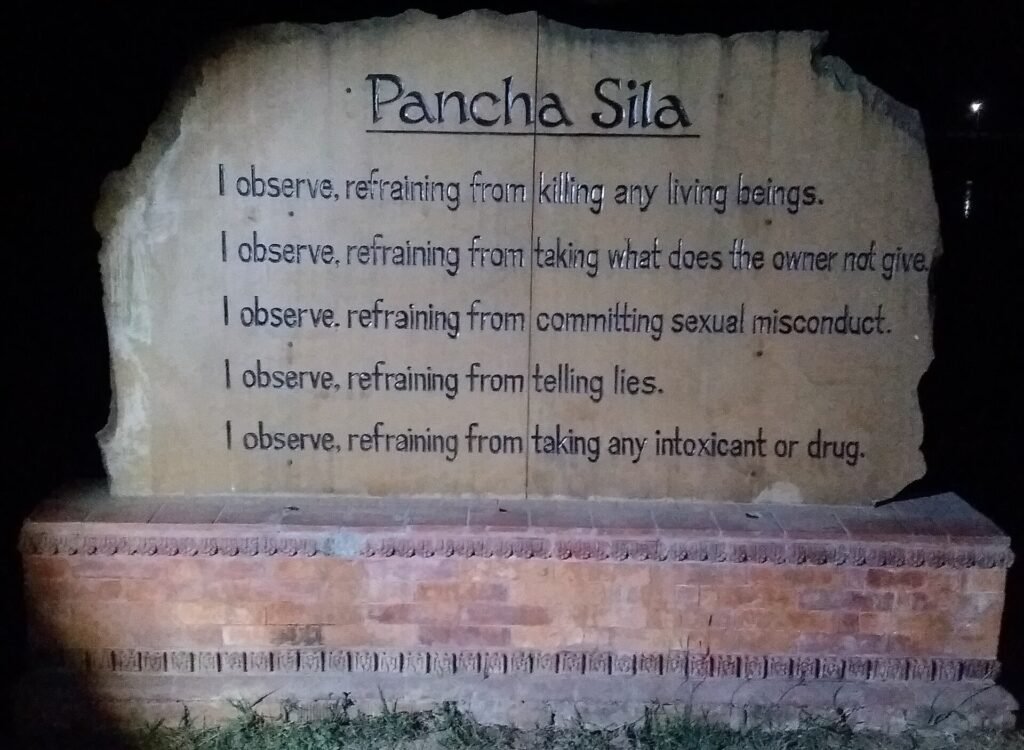
Photo by Farang Rak Tham: Plaque with the five precepts of Buddhism engraved, in Lumbini, Nepal.
Available online HERE under a Creative Commons License.
The Most Venerable Thich Nhat Hanh begins this chapter by observing:
“Right Action (samyak karmanta) means Right Action of the body. It is the practice of touching love and preventing harm, the practice of nonviolence toward ourselves and others. The basis of Right Action is to do everything in mindfulness.”
Cultivating morality, alongside generosity, has formed the foundation of Buddhist practice for communities and cultures for centuries. Chief among the ways that this practice has been universally expressed is the Five Precepts. Thich Nhat Hanh and the Plum Village tradition have also offered the Five Mindfulness Trainings as an example of how to work with the precepts in daily life. Through these practices, we learn so much about the path, including insights into impermanence, karma, and its fruit. We also get to directly experience the unity of wisdom and compassion on the Buddha’s path. Our decisions are not random or haphazard, but the result of ongoing and careful attention. This integration is found in each Mindfulness Training. They begin with a skillful turning toward suffering, bringing into awareness the harm caused by our unskillful actions born of greed, hatred, and delusion. But instead of this awareness overwhelming us, we use it to skillfully shape our actions of body, speech, and mind. Wisdom empowers our compassion to be effective, and compassion empowers our wisdom to relieve suffering. “Looking deeply,” writes Thich Nhat Hanh, “we can see the interbeing nature of the Five Mindfulness Trainings and the Eightfold Path.”
| The Wisdom and Compassion aspects of the Mindfulness Trainings. | |
| Wisdom Aspect | Compassion Aspect |
| 1. Aware of the suffering caused by the destruction of life, | I vow to cultivate compassion and learn ways to protect the lives of people, animals, plants, and minerals. |
| 2. Aware of the suffering caused by exploitation, social injustice, stealing, and oppression, | I vow to cultivate loving kindness and learn ways to work for the well-being of people, animals, plants, and minerals. |
| 3. Aware of the suffering caused by sexual misconduct, | I vow to cultivate responsibility and learn ways to protect the safety and integrity of individuals, couples, families, and society. |
| 4. Aware of the suffering caused by unmindful speech and the inability to listen to others, | I vow to cultivate loving speech and deep listening in order to bring joy and happiness to others and to relieve others of their suffering. |
| 5. Aware of the suffering caused by unmindful consumption, | I vow to cultivate good health, both physical and mental, for myself, my family, and my society by practicing mindful eating, drinking, and consuming. |
Today, as certain aspects of Buddhist practice have become more popular in mainstream society and culture, Right Action is often separated from the path or even forgotten. In “The Healing Power of the Precepts,” Thanissaro Bhikkhu points out that:
“There’s a modern tendency to dismiss the five precepts as Sunday-school rules bound to old cultural norms that no longer apply to modern society, but this misses the role that the Buddha intended for them: as part of a course of therapy for wounded minds.”
Thich Nhat Hanh’s chapter embodies why Right Action remains vital to the path, while Thanissaro’s article offers correctives to that easy dismissal that we have likely already encountered – consciously, unconsciously, or both.
For this introduction, we’ll focus on the points of “The Healing Power of the Precepts.” In it, Ajahn Thanissaro outlines four qualities or standards that the precepts embody – and teach us to embody in our actions of body, speech, and mind. They are:
- Practical: Ajahn Thanissaro’s point that “It’s entirely possible to live in line with these standards—not always easy or convenient, maybe, but always possible” is very important. Another aspect of this is that the precepts are a practice. We use the precepts as a way to learn to pay attention and make skillful choices. Impossible standards push as away from practice. Why bother to try? We can easily become discouraged or even psychologically damage ourselves. While it is true that practicing with the precepts and Mindfulness Trainings requires us to look and listen deeply at situations and decisions that are uncomfortable and even painful, we do not do so with the goal to condemn ourselves and others. The practice is to better understand and then make choices that best express a wise and compassionate response to those conditions. “If you can give people standards that take a little effort and mindfulness but are possible to meet, their self-esteem soars dramatically as they find themselves actually capable of meeting those standards. They can then face more demanding tasks with confidence.”
- Clear-cut: Although our ethical decisions often feel complicated when embedded in the suffering of samsara, the precepts themselves offer “very clear guidance, with no room for waffling or less-than-honest rationalizations.” Thanissaro gives a good example of this with regard to using convenience as a rationalization to kill another living being: “that would place your convenience on a higher level than your compassion for life. Convenience would become your unspoken standard—and as we all know, unspoken standards provide huge tracts of fertile ground for hypocrisy and denial to grow.” As we have explored, delusion thrives in this kind of confusion and it then becomes easy to justify greed and ill-will. The precepts provide a healthy sense of clarity in the face of this confusion that can then help us to create habits, relationships, communities, and cultures that provide “unlimited safety for the lives of all,” “unlimited safety for their possessions and sexuality, and unlimited truthfulness and mindfulness in your communication with them.” As the Most Venerable Thich Nhat Hanh teaches, Right Action is “the practice of touching love and preventing harm”.
- Humane: Thanissaro Bhikkhu brings together our practice of the precepts with the practice of “aligning yourself with the doctrine of karma, which teaches that the most important powers shaping your experience of the world are the intentional thoughts, words, and deeds you chose in the present moment.” The Buddha’s teachings on Right Action cannot be separated from his teaching on karma. These teachings help us to remember the opportunity and power of living skillfully and mindfully. But they are also wise, helping us understand that our actions of body, speech, and mind exist within complex relationships between past karma of ourselves and others, as well as other causes and conditions. Bringing wisdom and compassion together, we don’t get caught in dualities like praise and blame or approval and disapproval. Instead, we measure ourselves “in terms that are entirely under [our] control: [our] intentional actions in the present moment.” This wise compassion helps create conditions where we and others can thrive with trust, care, and mutuality – a truly humane way to live with ourselves and others.
- and Worthy of Respect: The Mangala Sutta reminds us that “to live in the company of wise people, / honoring those who are worth honoring — / this is the greatest happiness.” As we deepen our practice of the precepts and more clearly perceive how they embody wisdom and compassion, our confidence in them grows. But so does our gratitude for those who dedicate their time, energy, and resources to develop and embody them. We gravitate more and more towards building relationships and communities where these precepts are shared both as values and in practice. We find ourselves more at ease. We enjoy the gifts of safety and mutual care as we live “as a full-fledged, responsible human being.” We also become more comfortable with and confident in spending our lives in just this way, even when we also feel the pressure to abandon these standards. “Other people may not respect you for living by the five precepts,” writes Thanissaro, “but noble ones do, and their respect is worth more than that of anyone else in the world.”
So, what about the Mindfulness Trainings? These are likely examples of the kind of elaborations of the precepts that Thanissaro criticized, and his cautions are important. If we find ourselves using the Trainings in ways that obfuscate how they are practical, clear-cut, humane, and worthy of respect, we need to pause and work with that. While this is true of working with the precepts in their simpler forms, there are even more opportunities to handle Mindfulness Trainings unskillfully.
This is especially true when we bring collective Right Action into our awareness. For example, Thanissaro cautions against expanding the second precept to include “abuse of the planet’s resources”. While such applications may “sound more lofty or noble,” it is also “impossible to live up to them.” And the risk is greatest when we take personal responsibility for collective karma and action. No one person, or even community, can bring ecological healing to the planet. When we work with the Mindfulness Trainings, it is important to reflect on personal Action, collective Action, and the relationship between the two.
Another aspect for awareness is particularly important for those of who come from some variety of a purity culture. This can arise with any combination of sexual, moral, ideological, religious, or other social and cultural identities. The widespread political and social polarization increasingly experienced around the world is both driven by and perpetuates this grasping for purity. Obsession with controlling people’s behavior and thoughts (actively promoting fanasticism and attachment to views) often depend on strategies like reward and punishment, exclusion, shame, and fear that actively reduce opportunities to practice Right Mindfulness and Right Action. This is one aspect of the prevalence of regret and denial that Thanissaro Bhikkhu discusses and is a powerful example of how “Modern meditators in particular have been so wounded by mass civilization that they lack the resilience, persistence, and self-esteem needed before concentration and insight practices can be genuinely therapeutic.”
All of this connects with Ajahn Thanissaro’s insight that:
“It’s hard to be good-hearted and generous when the society immediately around you openly laughs at those qualities and values such things as sexual prowess or predatory business skills instead. This is where Buddhist communities come in. They can openly part ways with the prevailing amoral tenor of our culture and let it be known in a kindly way that they value good-heartedness and restraint among their members. In doing so, they provide a healthy environment for the full-scale adoption of the Buddha’s course of therapy: the practice of concentration and discernment in a life of virtuous action.”
As we practice with Right Action this month, return frequently to the words Thich Nhat Hanh uses to introduce the chapter. Notice how Right Action depends on the other factors of the Path. Notice how Right Action “means Right Action of the body”, and what that means as you go through your day. Notice all the opportunities for Right Action to be “the practice of touching love and preventing harm, the practice of nonviolence toward ourselves and others.” And enjoy the fruit of bringing wisdom and compassion, so that the basis of our choices “is to do everything in mindfulness.”
Thank you for your practice! Namo Shakyamuni Buddhaya. Namo A Di Da Phat.
Links:
– The Five Precepts via AccessToInsight
-Mindfulness Trainings, Current, Via Plum Village
–Mindfulness Trainings, Historic, Via the Dharma Teacher Order
Reflect:
- Why is “The basis of Right Action … to do everything in mindfulness”? How does Right Action connect with nonviolence and “the practice of touching love and preventing harm”?
- The Most Venerable Thich Nhat Hanh encourages us to think about and practice the Second Precept (“I undertake the training-precept to abstain from taking what is not given”) with awareness of “the suffering caused by exploitation, social injustice, stealing, and oppression”. How is this a reflection of the interbeing of personal and collective wellbeing, suffering, and Right Action? Why is it that, “When we do something to promote social justice, that is Right Action”?
- The Fifth Precept is to “undertake the training-precept to abstain from alcoholic drink or drugs that are an opportunity for heedlessness.” How does the Most Venerable connect this with mindful consumption? Why is preventing heedlessness part of Right Action?
- What are some of the connections between Right Action, personal healing, collective healing, and the Bodhisattva Path? How does this compare with Thich Nhat Hanh’s point that “A good teacher only needs to observe a student walking or inviting a bell to sound to know how long he has been in the practice”?
Practice:
- Each week of this month, focus on one of the Five Mindfulness Trainings. In whatever way works well for you, recite the training at least twice daily. Use it to both as a way to train in Right Thinking/Right Aspiration (e.g., today I will practice awareness of my actions with regard to this mindfulnes training, with the aspiration to train actions of body, speech, and mind in wisdom and compassion) and to train in Right Effort (e.g., with awareness of this mindfulness training, are there any unskillful actions of body, speech, and mind that need to be avoided, released, and transformed? What skillful actions can be taken up, nourished, and strengthened into habits?)
- Make a chart of the Five Precepts/Mindfulness Trainings and use it to support skillful contemplation of Right Action. You can use reflective questions like these, or create your own.
- Precept/Mindfulness Training:
- Right Aspiration: What qualities or virtues are to be developed?
- Right Effort: What unskillful actions are to be avoided/abandoned? (personal)
- Right Effort: What unskillful actions are to be avoided/abandoned? (collective)
- Right Effort: What skillful actions are to be developed/strengthened? (personal)
- Right Effort: What skillful actions are to be developed/strengthened? (collective)
- Having worked more intentionally with the Five Precepts/Mindfulness Trainings, look deeply at your own practice:
– How do you think about the precepts/trainings? What is their place on the Buddhist path? How do they relate to the other aspects of the Eightfold Path?
– Which practices come more easily to you? Why do you think that is?
Which practices are more of a struggle? Why do you think that is?
– How do you experience the connections between personal and collective practice of the precepts?
– When are these connections a strength, supporting skillful practice? When do these connections become an obstacle, making skillful practice more difficult?
– One common way of reflecting on practicing the precepts is to contemplate when you observe them informally (they are in your awareness and may even be important to you, but you have not taken vows), formally (you have committed to practicing the precepts, such as receiving the precepts while Taking Refuge), and spontaneously (you have integrated the precepts into your life so that they have transformed your way of living; some traditions reserve the full expression of this for arahants/bodhisattvas). How would you characterize the ways you practice Right Action in these categories?
4) Continue outlining a daily practice organized around the Eightfold Path:
- What does Right Action mean to you?
- What aspirations do you have for the cultivation of Right Action?
- What practice(s) will you develop to support that cultivation?
- How will you recognize growth in the practice of Right Action?
Remember: the goal of this practice is to match the insights we cultivate through the Buddha’s teachings with our personal and changing circumstances. Some habits will become long-term, while others may be more situational. Paying attention to our changing conditions and adapting our practice are also part of the path.
–end–